Welcome back, Hunters and fellow developers! If you are reading this, you probably have already blasted your way through the haunted mansions and eerie forests of the earlier levels in Invisible TeleGhostHunter. Or, maybe you are an indie game developer looking for some behind-the-scenes magic. Today, we are opening up the vault and taking you on a deep dive into the creation of our most ambitious, mind-bending, and visually striking stage yet: Level 7 – The Binary Abyss.
In this exclusive developer log, we are going to break down the creative ideas that sparked this level, the exact technologies we used to bring it to life directly in your web browser, the challenges we faced, and why, out of all the stages we have designed, Level 7 holds a special place in the heart of our lead developer.
The Spark of the Idea: The Ghost in the Machine
When we first sat down to brainstorm Level 7, we hit a creative roadblock. We had already done the spooky graveyards. We had done the abandoned hospitals. Where do you go when you run out of physical haunted locations?
The answer hit us during a late-night coding session: What if the ghosts aren't in a physical place anymore? What if they are in the code itself?
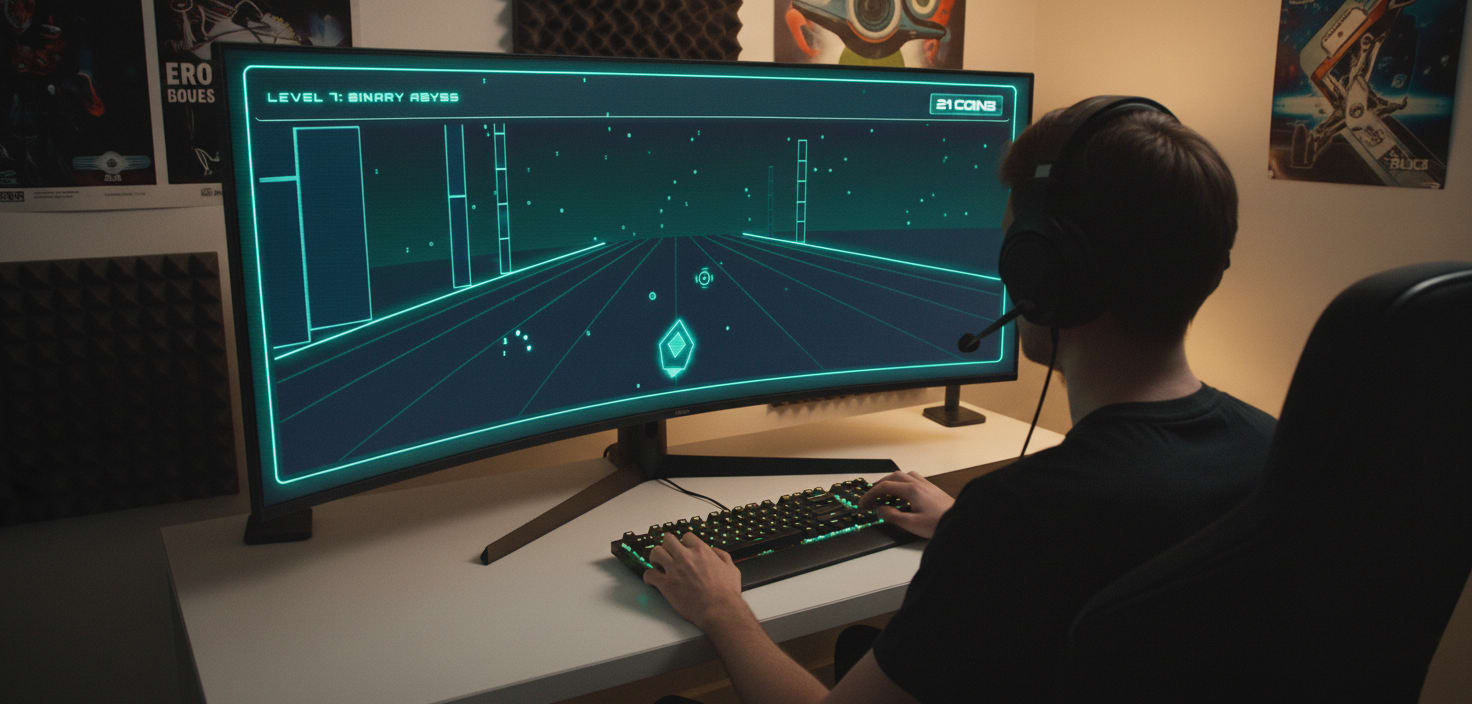
We wanted to pivot from classic gothic horror to a gritty, cyberpunk, retro-futuristic vibe. We imagined a scenario where the rogue spirits, realizing they were being hunted, retreated into the core architecture of the internet—the mainframe. We called this digital wasteland the "Binary Abyss".
But then came the real design challenge: How do you hunt an invisible ghost inside a computer? In previous levels, ghosts were slightly transparent images (PNGs) floating across the screen. For Level 7, we decided to scrap images entirely for the enemies. Instead, we used raw text. The "invisible ghosts" are represented only by rapid, chaotic flashes of binary numbers ('0's and '1's) that glitch in and out of the neon sky. You aren't shooting a monster; you are deleting a corrupted process. This single idea changed the entire trajectory of the level and made it feel completely unique.
The Technology Stack: Pure Web Power
You might think a fast-paced action game with 3D-scrolling backgrounds, matrix rain, and dynamic screen shake requires a massive game engine like Unity or Unreal. But one of our core philosophies for Invisible TeleGhostHunter is accessibility. We want you to play it instantly, on any device, without downloading anything.
Therefore, Level 7 was built using pure, vanilla web technologies. Here is the exact stack we used:
HTML5 Canvas (The Drawing Board)
The heart of Level 7 is the <canvas> element. Instead of moving HTML elements around the screen (which is slow and clunky), the Canvas API allows us to draw pixels directly to the screen at 60 frames per second. Every building, every laser blast, and every binary glitch is mathematically drawn and redrawn continuously by our game loop.
Vanilla JavaScript (The Brain)
No heavy frameworks. No external libraries. Just pure, unadulterated JavaScript. We used JS to handle the game state, track the mouse/touch movements for the custom crosshair, calculate the math for the scrolling road, and manage the hit-detection when you fire your weapon.
CSS3 (The Retro Vibe)
While Canvas handles the gameplay, CSS3 handles the atmosphere. We used advanced CSS styling to create the glowing neon borders and, most importantly, the CRT Scanline Overlay. By using a clever CSS linear-gradient layered over the game container, we created the illusion that you are playing the game on an old, curved arcade monitor from the 1980s.
Web Audio API & Web Speech API (The Senses)
Instead of forcing you to download bulky MP3 files for sound effects, we generated the audio on the fly using the browser's native Web Audio API. When you shoot your laser, the browser literally synthesizes a "sawtooth" audio wave that drops in frequency. When you miss, it plays a "triangle" wave.
To top it off, we used the Web Speech API to give you an AI companion. The robotic voice that says "Binary Abyss activated" is generated natively by your device's text-to-speech engine!
Overcoming the Coding Challenges
Building Level 7 was not a walk in the park. Translating our ambitious ideas into smooth, playable code brought several major headaches. Here is how we solved the biggest challenges.
Challenge A: Creating Fake 3D on a 2D Canvas
We wanted a road that rushes toward the player and towering "Data Node" buildings that zoom past you. But the HTML5 Canvas is strictly 2D (X and Y coordinates). How did we do it?
The Solution: Perspective Math. We created a fixed "horizon line" in the middle of the screen. For the road, we drew a shape that is narrow at the horizon and ultra-wide at the bottom of the screen. As for the buildings, we wrote an algorithm that sorts them by their Y-position. Buildings closer to the horizon are drawn tiny and move slowly. As their Y-position moves down the screen (closer to the player), we multiply their width, height, and speed by a "scale factor". This trick tricks your brain into seeing deep 3D space, even though it is entirely flat!
Challenge B: The Invisible Hitbox
Because the ghosts are just flashing text ('1's and '0's) that randomly appear and disappear, clicking directly on a single pixel of a number was impossible. Players were getting frustrated.
The Solution: Forgiving Radius Math.
We implemented a hidden circular "hitbox" using the Pythagorean theorem (Math.sqrt(dx * dx + dy * dy)). Even though the ghost looks like a scattered glitch, the code tracks a central invisible point. If you click anywhere within a generous 35-pixel radius of that center point, the game registers a hit. It makes the player feel incredibly accurate and skilled without being unfairly punishing.
Challenge C: Making the Game Feel "Heavy"
Shooting an invisible target felt a bit... hollow. There was no physical impact.
The Solution: Screen Shake.
We introduced a triggerShake() function. Whenever you hit a ghost, and especially when you clear a glowing "Data Anomaly", the game randomly shifts the entire Canvas context by a few pixels back and forth for a fraction of a second. Combined with the synthesized explosion sound, this tiny bit of math makes the digital weapon feel incredibly powerful and provides immensely satisfying haptic feedback.
Expanding the Gameplay: The Data Anomalies
We realized early in playtesting that just shooting invisible ghosts that pop up randomly got repetitive after a few minutes. We needed a secondary layer of strategy.
Enter the Data Anomalies.
These are glowing, hexagonal shapes (drawn using trigonometric Math.cos and Math.sin functions) that spawn randomly in the abyss. We added a "decay" mechanic to them—their opacity slowly drops until they disappear.
This created a brilliant "Risk vs. Reward" system. Do you keep your eyes peeled for the invisible ghost to maintain your accuracy? Or do you flick your mouse over to the Anomaly to secure 5 bonus coins before it vanishes? This forced players to make split-second decisions, elevating the gameplay from a simple clicker to a true action-arcade experience.
Why Level 7 is the Developer's Absolute Favorite
If you ask our lead developer which stage of Invisible TeleGhostHunter they are most proud of, the answer is always Level 7. But why?
It is a Masterclass in Optimization
As developers, we are obsessed with performance. Level 7 features a scrolling 3D road, 30 dynamic buildings pulsing with neon lights, 60 particles of Matrix-style code rain falling, spinning anomaly shapes, glowing custom crosshairs, and screen-shake calculations—all running simultaneously in a web browser without a single drop in framerate. Achieving that level of visual chaos while keeping the code lightweight and lightning-fast is a massive point of pride.
The Pure Cyberpunk Aesthetic
From a visual design standpoint, Level 7 is a love letter to 80s sci-fi, cyberpunk, and the synthwave music scene. The stark contrast of the neon cyan and electric purple against the deep, pitch-black void creates a mesmerizing visual experience. It doesn't look like a standard web game; it looks like an arcade cabinet from a futuristic arcade.
It Relies on Pure Player Skill
In many modern games, success is determined by unlocking better gear or grinding for levels. Level 7 strips all of that away. You are dropped into the Binary Abyss with nothing but a crosshair and your own reflexes. Because the enemies are invisible, you have to enter a "flow state", relying on your peripheral vision and audio cues to win. When a player finally hits that 70-coin target and unlocks the Kernel Access screen, they know they achieved it through pure, unadulterated gaming skill.
Keep your optical sensors clean, Hunters. The code is constantly shifting, and we will see you in the next update!
Did you enjoy this deep dive into the code? Are you an aspiring developer or a hardcore Ghost Hunter? Let us know what you think of Level 7! If you haven't played it yet, boot up your system and dive into the Binary Abyss today. Share your high scores and accuracy ratings with us on social media using the hashtag #TeleGhostHunter.